Translate

Sunday, November 3, 2013

Fleshgod Apocalypse -AGONY (Album Review)

I know, it's strange and a massive departure from what this blog usually focuses on, but I just had to put my thoughts on this down somewhere.

Fleshgod Apocalypse, the Italian technical death metal outfit (and please don't let the label put you off!) released the concept album Agony back in 2011. In August this year they released a second conceptual work entitled Labyrinth, which I have not yet heard in full and so cannot comment on.

So who are Fleshgod? They came to prominence quite recently, releasing their debut album Oracles in 2009 and later an EP entitled Mafia in 2010. They have been seen within the international metal community as a force to be reckoned with as a result, blending together the brutality of death metal with the ambience of classical music, with all five members of the band being classically trained in their instruments, as is apparently common in Italy according to the band. And nothing exemplifies such training as listening to this album. It's warm, it's symphonic, it's operatic yet it's also cold, destructive, explosive and even eerie to the point of chilling. This album, is all of this and more throughout its 10 tracks.

According to the band, the concept of Agony surrounds the idea of the destructiveness of the human condition, which always ends, inevitably, in agony for the perpetrators. The track listing is the first indication of what they were trying to encapsulate (and boy did they succeed!) with an obvious pattern:

1- Temptation [Instrumental]
2- The Hypocrisy
3- The Imposition
4- The Deceit
5- The Violation
6- The Egoism
7- The Betrayal
8- The Forsaking
9- The Oppression
10- Agony [Instrumental]

Bonus Track- Heartwork (a Carcass cover; it's kind of separated from the main body with some 10-15 seconds of silence.)
The Masterpiece that is Agony!

It's also worth noting that if you buy a physical copy (which I would highly recommend) the songbook, (which unfortunately doesn't have lyrics, but definitions of each word after which each song is named) has a quote from The Divine Comedy by Dante (Inferno Canto XXVI Verse 118-120.) The quote is written in Latin, but if you have copy of Dante's classic in English, then obviously look it up. This is a very nice touch I feel because it's almost like each track represents a circle of Hell e.g. Betrayal for the traitors like Mordred (from Arthurian legend) in the poem, (Inferno Canto XXXI: "him who, at one blow, had chest and shadow / shattered by Arthur's hand.")

But moving on from the overall concept, what is the music like? Well as you'd imagine, it's often frantic, fast-paced and the vocals are usually roared/grunted in low, animalistic pitches by frontman Tommaso Riccardi. But there are also high-pitched, operatic vocals emulating from bassist Paolo Rossi, which often weave rhythmically between the traditional tech death vocal style (you can see examples of this on the track, The Forsaking, a slower song.) However, there are also times where these vocals offer a whole chorus between the death-like verses a la The Violation or The Oppression. These are not standalone tracks or even the greatest on the album, because the whole work doesn't stand or fall on its singles. Why is this? To explain I'll now move onto the symphonic elements.

Symphonically, the album has a variety of ebbs and flows in its instruments, points where violins are more prominent or points where flutes and other instruments dance around the light-speed drumming. This is what makes the album doubly effective. As some tracks end with fairly slow outros, the next track will often pick up from that with a metallic sound, changing the orchestral arrangement to begin a new track that not only advances the work seamlessly but also sounds different enough to be recognisable. To put it simply, there are occasions on the album where an outro of one track acts as the intro of the next simultaneously, an effect epitomised by The Violation. The music video for this track below begins with the uncanny classical intro, before lurching into the thunderstorm of death metal delight! This is because that 'intro' for the video of The Violation is actually the end of The Deceit, but because it flows so brilliantly, they were able to take those two pieces of essentially different songs and merge them into one for a video. The same effect is also used oddly enough for the music video for the second single released, The Forsaking, with the intro, again, being in fact the outro of The Betrayal.


 The Violation: A thrill-ride of insane drumming, shredding guitars, haunting woodwind sections and brutal vocals.


The Forsaking: The slow song with eerie vocals, 
ambient echoes, and a beautiful piano overlay.

In terms of how this effect changes the album, it causes the whole work to flow so well that the whole thing on some occasions feels like a single track, a whole symphony, which is what they were going for to some extent. Some may find this to be too repetitive, but personally I don't really think it is because even though discerning the lyrics is quite laborious (here's a good site for the lyrics by the way,) you can tell that there's certainly a story being told, a journey being embarked upon, which is what gives this whole album a fantastic appeal to those who aren't even into popular varieties of metal (even my parents enjoyed it!) To put it short, the journey from a small Temptation through to blistering Agony is one that you will want to take again, and again, and again!

To finalise this review, I'm going to identify some standout points for each musician, the parts where they really show their talent!

Tommaso Riccardi: Although he has a brilliant voice throughout the entire duration of this album, the vocals are especially appealing due to the difference between this track and the others, which is why I'm identifying The Forsaking as the standout track for him, the echoes and reverberation are just so chilling when adjacent to the piano on this track, it's uncanny.

Paolo Rossi: Unfortunately, the bass work is often drowned out of the mix by the strings (a common criticism of the album in fact,) though there are some good moments across numerous tracks. But his operatic vocals are where he really shines! The Oppression, where he tackles the chorus is where he raises his voice so high yet unbelievably remains on key throughout, testament to his classical training no doubt.

Christiano Trionfera: The guitar work has very good standout parts in the track The Betrayal, where it penetrates the wall of drumming and symphonic parts with seamless shifts in pitch that match the surrounding sound in such a way that it just fits perfectly with the mix and makes a marked difference to that track compared to the rest of the album.

Francesco Paoli: The drumming is what really got me into the album, being a drummer myself! The fast-pace on The Violation in particular is what really got me sold on the whole thing, the sheer power and force just makes you want to quiver with adrenaline and break everything in sight, an effect that is maintained through the entire album, with a possible exception seen on The Forsaking.

Francesco Ferrini: The conductor of the orchestra and pianist; whilst his work with the whole symphonic arrangements is quite possibly the most innovative contribution to the work, his piano skills are fantastically exemplified on the outro track Agony. This classical track is so haunting and so skilful that upon listening to it I could tell that the journey had ended; I could just imagine it being played over a video of someone being tortured and therefore in agony, the epitome of the concept and a clearly marked difference to the intro, Temptation, which begins with a crescendo of drum rolls and strings, building tension throughout. The track Agony only has a piano on it, and makes full use of it's player!

I hope that you enjoyed this rather long review, and if you like it (the album or the review) please, get in touch!

Thursday, October 31, 2013

Carat Media Internship: Journal Entry #4

* Written last week, but also needed managerial approval.

So here we are again; in the world of AMNET at Carat! One of the first things I did today was attend a short lecture from the Head of Social on the industry developments surrounding SMM and its implications within Carat. It was very enlightening, featuring several infographics and colourful images demonstrating the power of the tool in such a concise and imaginative way; (unfortunately I haven't been able to get a copy of the Powerpoint to show on here yet, but hopefully I'll come across it next week and update this post!)

The presentation was very interesting, specifically the idea of interaction on the part of consumers when it comes to social, the interaction with brand pages being conceptualised as the "Zero-th Moment of Truth," the stage preceding the point at which you see a product on the shelf (1st moment) and then buy  it (2nd moment.) This contributed massively -I thought- to the idea of social commerce (where we 'sell' goods to each other) because most social interactions tend to come from a viral or 'eWOM' effect, (I may discuss this more in a future post.)

After the presentation, the real work commenced: First of all I was shown through the various metrics surrounding new platforms such as MediaMath & DFA (Doubleclick for Advertisers.) These programmes are essentially cross-reference programmes for advertisers and publishers showing the performance of ads placed on various channels. This makes it particularly important for display advertising, the transaction process for which I've reconstructed below for your benefit. Check out the advertising I'm giving Carat right now!

Display Marketing: A Simple Transaction Process

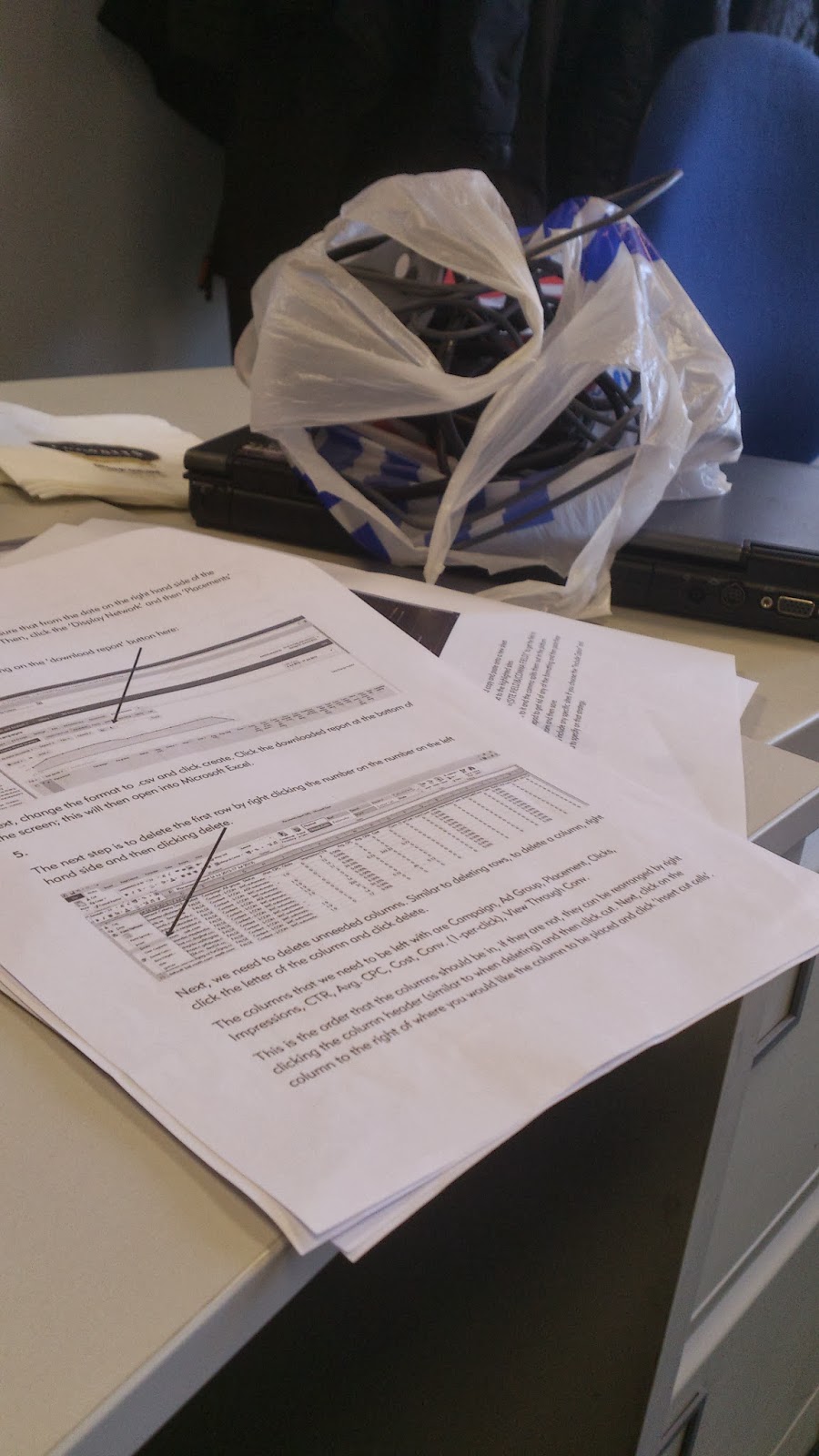
It was quite daunting listening to someone explain how it all worked, a great deal of it going over my head initially to be honest. I was shown the process -using Excel- of creating a VLOOKUP, a tool with which you can link together two different spreadsheets, which I have yet to actually use in practice so hopefully we'll see how much I can remember next week!

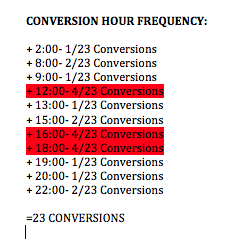
What I did today primarily consisted of working with Excel reports sent over from DFA and MediaMath, analysing some keywords and campaigns along with CPC/CTRs as well as CPAs (Cost per Acquisition.) The workbooks tended to consist of greater numbers of spreadsheets, which can easily snow you under with too much to do of course if you're not very organised. Fortunately, after a bumpy start, I got the hang of organising the data through KPIs such as Clicks and Conversions, highlighting data as I went and sending off the workbooks to my colleagues.


In all, today I've worked with interesting people and have enjoyed working with the programmes I've been getting used to over this last month or so. It's really proved useful so far, so much so in fact that one of my assignments for university will be needing some Excel skills like Pivot tables, something that I was completely clueless about until I came to Carat! And it is with great anticipation that I will see you next week, when I will probably be going through the results of the campaigns I've been analysing!   

Carat Media Internship: Journal Entry #3

* Please note that this was written a couple of weeks ago because it needed managerial approval before i could be posted. Thanks!

Last week proved rather eventful at work. I completed some more tasks for our clients through Facebook, made recommendations and wrote a lot of it down. But this week I moved onto something else! The new task still revolved around using Excel but instead of Facebook, I used Google's Display Network (GDN) to find the info.

Unfortunately I haven't yet used the actual platform but instead manipulated the data to discern some useful information. I used the Filter option within the spreadsheet to select certain data that fell within a certain range e.g. CPCs at £0.25+ only. This was usually in conjunction with another function such as selecting the column for CTRs and setting the filter to have the values in descending order from the highest. When used together, those two functions should leave the top of the table filled with the data ranges containing the highest CTRs only with 25p CPC or more. Combining several filters is how you can really drill right down into the most significant factors and when you discover bad/good data, you can highlight it appropriately.

However, once discovering the data needed, I wrote explanations for why the data was how it was, analysing the source of the traffic and -when looking into the Google Keywords spreadsheet- evaluating the most effective websites in addition to discussing not only the keyword used, but also the Ad Group into which it fell i.e. a keyword of "things to do 2013" would fall into the Ad Group of "things to do," with possibly several options added for as many keywords as were deemed necessary when the campaign was initially set up.

As the weeks go by I find myself going through the Excel sheets with greater speed as the processes become memorised and I jump from place to place, setting the controls appropriately as I go. Not only that, but I find that my analytical skills are improving and as I become more confident with Excel, I try to do things to the sheet that aren't on the list e.g. re-setting the filters in yesterday's case to try and prove a hypothesis about the data that I had, organising the filter through the keyword and Ad Group to see the frequency of failure in a specific campaign that I had doubts of.


 My Professional Development Assignment for the university; I need to prove that I've developed some sound skills and competencies, as well as a mature approach to work behaviour and a good attitude to the job/field.


Sorry if this post is a little short/sparse on info, I didn't want to fall into the trap of repeating myself week in week out and boring you to death! Not only that but yesterday I had to take a slightly longer lunch break because of a university meeting that unfortunately clashed with the work hours. But I did stay a little longer than usual though so I suppose I made up for it!

Week 2
Week 4

Tuesday, October 22, 2013

A Clockwork Orange (Book Review)

Well here I am, writing the book review for Anthony Burgess' classic novella A Clockwork Orange (1962,) a book that was banned alongside its film adaption directed by Stanley Kubrick (1972) for its extreme violence and depiction of sexual crimes. The film was only one of four films to ever be banned in the history of British cinema, requested by Kubrick himself upon receiving death threats over it; the film adaption was reinstated upon his death in 1999, as was agreed. The story is supposed to be an argument against the ethics of taking away the choice of being good or evil so that good will flourish, thereby transforming someone into a 'piece of clockwork', incapable of something intrinsically human and therefore ceasing to be human.

The trivia on the film is not entirely relevant however, though I should possibly point out that before reading this book, I had seen the film a couple of years ago and so could draw upon some visuals or pinpoint from memory, the whereabouts of a scene in the film, in the book. Watching the film is not necessary, though I would highly recommend that you watch it for its brilliant acting and soundtrack. The book is just as good but for very different reasons.

One of the main reasons why many people -at the time and even today- found problems with this book is the fact that it uses very idiosyncratic language (adapted from Russian dialect called 'Natsat') in its first-person narration. Words like 'tolchock' (punch or beat,) 'gulliver' (head) and 'horrorshow' (good) are used to abandon. This can easily put the tired reader off but fret not, for you will get used to the neologisms. Personally, I picked up the context of the words fairly quickly and as a result blasted through it, which is why I finished it these last three days. This is the first reason why it may not be for everybody, the second of course is the violent/sexual content, which, for some odd reason, I found amusing if anything. There are scenes in the book where people are beaten to pulps, humiliated and killed, but it isn't just a book that's violent for the sake of it. So why should you read it, even if all that was off-putting for you?

Well this leads me to my review of the protagonist, Alex; a fifteen-year old lad who spends his time roaming the streets of an unnamed British city, terrorising all who cross the path of either himself or his friends, (named 'droogs' in the book.) Alex is more than that though, he is our narrator, writing his life-story almost in a cross between broken rhyming slang/Natsat/Middle English as he describes in vivid detail, the dystopian world in this future England; his exploits, the violence, the destruction and even his love of classical music, namely Beethoven's Ninth Symphony, all described in wonderfully-constructed detail, weaving between fast-paced dialogue that keeps you turning the page at lightning speed.

Now I don't want to give away any actual scenes, since pretty much all of them advance the plot in some way, the work being so short at barely over 150 pages. What I will say on narrative devices however is how brilliantly Burgess manages to reintroduce certain aspects of the book explored near the start, and use them as means of making something go full-circle and as a result, advances the character development of Alex page-by-page and scene-by-scene, making us actually like him by the end!

But what are the cons of this book: The book is mainly for those who are comfortable reading something that isn't entirely orthodox as far as language is concerned. To get around this however, you can always consult the glossary at the back or -my main tip- would be to just try and think of a substitute for the neologism and you should find yourself at a regular, Standard English sentence, and thus, you may even learn a new language by doing so! After all, who wouldn't want to tolchock someone in the gulliver real horrorshow?

Maybe not everybody, since this is the second non-criticism of the book; those who don't like a great deal of violence or weirdness might not like the story. I personally found it all quite tame, though I recognise that some people have different limits, so don't come back at me thinking I'm soft or some kind of pussy either! In the end we all have different views of what we like or don't in terms of the media we consume, and A Clockwork Orange is most definitely a book that I loved for its fast pace, interesting characters and innovative language use in its highly-intimate first-person narration, which kept me turning the page again and again.

My Edition: The Good4Books Store is Linked


Saturday, October 19, 2013

Brave New World (Book Review) & Comparison to 1984

As a preface to this particular review, here is my review of Nineteen Eighty-Four: http://jbwalkerwriting.blogspot.co.uk/2013/07/nineteen-eighty-four-book-review.html

Last night I finished the dystopian classic, Brave New World, written by English author Aldous Huxley in 1932. Because I've been quite busy recently it took a little longer than I originally anticipated to finish; but after two weeks of reading a chapter here and there I finally finished it. And I'm very glad that I did!

First of all I wish to recommend the edition of the book which I purchased, the Independent's Banned Books series, which can be bought from Play.com in the store: "Good4Books" This particular edition is in hardcover format and comes with a high-quality dust jacket; number 4 in the series of 25 novels and novellas that were highly-controverisal, (I have just bought Anthony Burgess' "A Clockwork Orange" from the same store in fact!)

But enough of the aesthetics, let's move onto the meat of the story! First of all I should note some similarities between both this novel and the novel published 17 years later in 1949 by George Orwell: Nineteen Eighty-Four. Aside from tackling the same genre, they also have similar characteristics in terms of their execution of what a dystopian society would look like. The trademark conditioning of oppression as normality is embedded within the world's of both stories, yet the two authors tackle the subject very differently. The main way in which this is implemented is in the methods in which oppression is applied to society, and the breadth of scale (don't worry I'll not spoil any plot details!) Namely, Huxley focuses on the scientific perspective of how humans would be 'manufactured' and innately stunted to a certain caste of society via biological engineering on a world-wide scale, whereas Orwell on the other hand, decides to confine us to a single country that is entirely regressive in its technology and focuses on the socio-political issues of censorship, taking info and rewriting it a la doublethink.

Linguistically, the novel is not as innovative as Orwell's seminal work, lacking in concepts such as "Newspeak" and "Doublethink," but does some interesting things with common language, taking expressions with "God" in them and replacing them with "Ford," because (Henry) Ford has been elevated into a god-like status in this Shakespearean "Brave New World" e.g. "cleanliness is next to Fordliness." This idea was borne of Huxley's view that science and technology was ultimately a dehumanising process, taking us down a materialist and consumerist path to being subdued by our own consumption. Looking at the world today he, like Orwell, may have been right!

I will not go into detail about the protagonists, but what do I think of the antagonist? Personally, I thought that all the characters were quite strong though I don't see the novel as character-driven, more world-driven (as it should be in this particular genre, perhaps?) And it is because of this, that one of my favourite scenes in the novel occurs towards the end where, like in 1984, the antagonist attempts to persuade the protagonists that the world is better the way it is under his control in that way. On this particular ground, I think that Huxley was more successful in making the character more likeable/empathetic than Orwell. I won't spoil why though!

So overall, what do I think? Huxley's writing style is simple enough, easy to understand and even the scientific concepts are easy to grasp. If you want me to judge this novel against Nineteen Eighty-Four however, then I'm afraid I must disappoint. It's hard to compare the two because of the ways in which they implement a similar idea; it's just a matter of which story you prefer personally due to individual tastes. There really isn't anything about one or the other that could be deemed as 'superior' in any way. In closing this review however, I would definitely recommend the book to absolutely anyone. It's easy to get into, it's a good, page-turning read and a much more fun world to inhabit -it seemed to me- than the darkness that pervades Nineteen Eighty-Four, as much as I like both novels' settings for different reasons. So if you read Orwell's work and didn't like the world in which it was set, then I would also recommend this on those grounds because despite the fact that Brave New World is dystopian, the methodology of its application is much brighter and high-key, making things seem at least a little less bleak!

The Banned Books Edition

Sunday, October 13, 2013

And the Ocean Crashes (Part II)

I wrote the second part to my short thriller/horror piece "And the Ocean Crashes" tonight. It was easier to write the second half than I thought it would be to be honest. In any case, if you haven't read the first half, here's the link: http://jbwalkerwriting.blogspot.co.uk/2013/10/and-ocean-crashes.html
   If you have then here's the conclusion. I hope that you enjoy it and I'm glad that you enjoyed the other half, if you did.


And the Ocean Crashes (Part II)

The door was a worn old thing, the dark pine chipped in places and the muddy paint flaking off, shards blowing in the light breeze that was beginning to accelerate. Yellow light escaped through the jarred door in a thin line that crossed one of his shoes. The breeze was slowly beginning to feel like a wind tunnel of force, whistling past his head in every direction, as the crash of the waves grew louder like a car bearing down on him on a busy road. He tensed his arms, placing his hands into his pocket to find his fingers caressing the warmth of his mobile phone. Without thinking he pulled it from his pocket, the fear of danger momentarily forgotten as the familiar sight greeted his eyes. The cyan pattern swirled along the smart phone’s screen like a soothing lava lamp against the dark background of a child’s bedroom. His safety dissipated as he saw the reception bar: Nothing.

His heart sank as if a chair was pulled from under his feet. He shoved the device back into his pocket, the breeze seeping through his shirt and into his bones like ice. His muscles began to twitch and his testicles began to shrink. His pupils grew like black holes as he fixed them upon the light seeping through the door; that warm, inviting light. His hand reached forward as thoughts literally grabbed the limb, the fingers twitching hesitantly in mid-air as his fearful ambivalence took hold, his train of thought derailed for a time.

He breathed in and out slowly as his hand became steady again, the fingers becoming still, lifeless. Without any further delay he pushed with all his might, as if the pine thing was a stone barrier. It swung with a short but loud creak as the wood thudded lightly against the interior of the shack, the light shining all over his body like a spotlight that had finally found him.

A man stood silhouetted before a blank wall, rats scurried around on the floor with light scratches as their claws dug into the wood. The man breathed horribly outwards as if his lungs were drowning in phlegm. The man turned around as the breeze intensified once more; sand was whipped into his face, blinding him as he lurched downwards, shielding his eyes as darkness took hold, a loud, oncoming thud clanked on the wood and just as he raised his head the man was before him: His teeth were yellowed and disgusting, his clothes even more so; soiled with months or years worth of dirt, the skin beneath blemished with a decaying pox that had pervaded the skin on his face. Buboes grouped around his lips with dried pus coating them; they looked like they’d burst all over him any moment. But the man’s hand was what took him; stretched out behind him as if in preparation for throwing a ball, the hand lurched towards his chest; the nails dirtied yet sharp and seemingly manufactured, cracked his chest with a dull thud. He screamed and gurgled as warm blood rushed towards his lips and trickled down his chin, his eyes filled with tears, blurring the inhuman face before him with its disgusting teeth smiling at him. His knees buckled as the fingers dug through him, draining his dignity as they searched for his heart that still beat faintly. He heaved as blood and vomit poured from his mouth and splattered on the floor. A second hand slipped it’s way between his legs as the thing’s teeth clasped around his neck and, just before the life slipped from his eyes and mind, a faintest crunch echoed in his head as the flame of life was extinguished.

And as the moon rises to it’s greatest height, the breeze continues to rip and tear mightily through the sea of sand across the far reaches of the archipelagos; the sand sits cold and black, while the thing drags the corpse in a bloody trail through its lazy clutches. He throws the remains into the embrace of the waters, the splash rising above the sound of the waves momentarily as the ocean crashes.     

Saturday, October 12, 2013

The Nescafe Facebook Page: A Content Review

In a spur of the moment decision, I've decided to put my thoughts out there on a Facebook page that I absolutely love. The Nescafe page with upwards of 12 million Likes.

In recent years as social media has taken off, companies have tried tirelessly to create engaging social pages that humanise their brands and products as much as possible. After all, brands aren't just products anymore, but lifestyles; a symbiosis of life between us just bubbling away at the surface of society and seeping through to its very roots, sitting all around us every day, wanting to tell us their story, their origins; (our friends at Carat published a similar blog post a while ago on the subject of 'Brand Narratives' and I would recommend that you check that out.) To many this is a permissible phenomenon whilst others have voiced disapproval. I reviewed the book No Logo by Naomi Klein some time ago now, just in case you want more on that particular perspective. But this is merely the background as to why companies try to be as innovative as they can, to attract the most social commerce.

And it is that point that leads me to this review of Nescafe. Why do I like it? Well, aside from being a routine buyer of their coffee, I've kept them in my timeline because of a few salient reasons: Firstly, they publish content regularly, unlike some other coffee companies such as Costa Coffee, who I also liked through Facebook (yes I'm a coffee addict!) This is crucial for any business trying to establish a firm base on a social media outlet, you need to keep it updated; it's like a blog, a tracker of your life and if it's neglected or under-updated overtime, consumers will begin to lose interest.

But with the baby steps of having the basic commitment out of the way, we can get down to the nitty gritty: Why is their content so special? Well that's for multiple reasons: The main one is that it's just plain funny, constantly playing upon people's general tiredness and need for constant energy, or more often just uploading cool pics with innovative ideas! Look at some of these recent images.


I'm Glad Monday's My Day Off This Year!


Smile!


They also recently uploaded a series of images forming a recipe for a Nescafe Milkshake! Like I said, the content is innovative, it's fairly original and it's a brilliant addition to their communication strategy. But the best thing about this or any other Facebook page is that -largely- it's free to do! Of course there was probably a great deal of cash that went into producing those images; the equipment, the staff etc. but even when that is considered, it's so much cheaper than filming an advert and spending vast sums on a national campaign. But in a final note, to revert back to the Carat article in particular, they have used the Facebook timeline -like many other companies- to detail their history in the world, their origins, their landmark coffees and their participation in key world events, (I didn't know they'd been on the moon!) and it is that common feature that so many brand pages share. They want to tell us their story, and the Story of Nescafe is one that I thoroughly enjoyed!

The only real criticism that I have of Nescafe's Facebook page is that they focus a little too much I feel on their Original blend or their general brand. Looking at the content produced, I feel it would be fairly easy to incorporate their other blends into something artistic that could raise awareness of their other coffees and product lines. An interesting dynamic can be seen between both the Nescafe page and their Nespresso page, both tackling different arms of Nestle's coffee ventures.

But in all, I find the Nescafe page a particularly good example of a brand making good use of a social platform to spread it's message, and it is for that reason that I thought I should share it!

Please, feed back to me about this. Do you have any Facebook pages of brands that you enjoy, whose content you like? Let me know, I'd love to hear about them!